Horse racing may look simple on the surface — the first horse past the post wins, right? But behind every race lies a wealth of information that tells the story of each contender: their past performances, strengths, weaknesses, how well they’re suited to today’s conditions, and so much more.
All that information is captured in one essential document—the racing form. For newcomers to the sport, the racing form can seem intimidating at first glance.
It’s packed with abbreviations, numbers, and racing jargon. But once you know how to read it, it becomes one of the most powerful tools for understanding the sport — whether you’re following Tropical Racing runner, analyzing a race at Gulfstream Park, or studying the runners and riders for the Kentucky Derby.
This detailed guide will walk you through the essentials of reading a racing form, from understanding the basic layout to interpreting key data like past performances, jockey and trainer stats, track conditions, and betting odds.
By the end, you’ll be able to read a racing form with confidence and enjoy the sport you love on a whole new level.
What Is Horse Racing Form?
A racing form (also known as a race card or program) is a detailed guide that lists all the information about each race and the horses entered.
It includes everything from race conditions and distances to each horse’s previous results, weight, and jockey.
In the United States, the Daily Racing Form (DRF) is the most widely used publication, while UK and Irish racing fans might refer to the Racing Post, or similar formats in Australia and Hong Kong.
No matter where you are, the purpose is the same — to provide a snapshot of each horse’s recent performance and potential in its next start.
For Tropical Racing members, understanding the racing form is essential. It’s how you follow your horse’s career — reading between the lines to know when a big run might be coming or what kind of conditions bring out their best.
The Layout: Understanding the Race Card
Every racing form is divided into races, with detailed entries listed for each horse in that race. Let’s break down what you’ll typically see at the top of each entry.
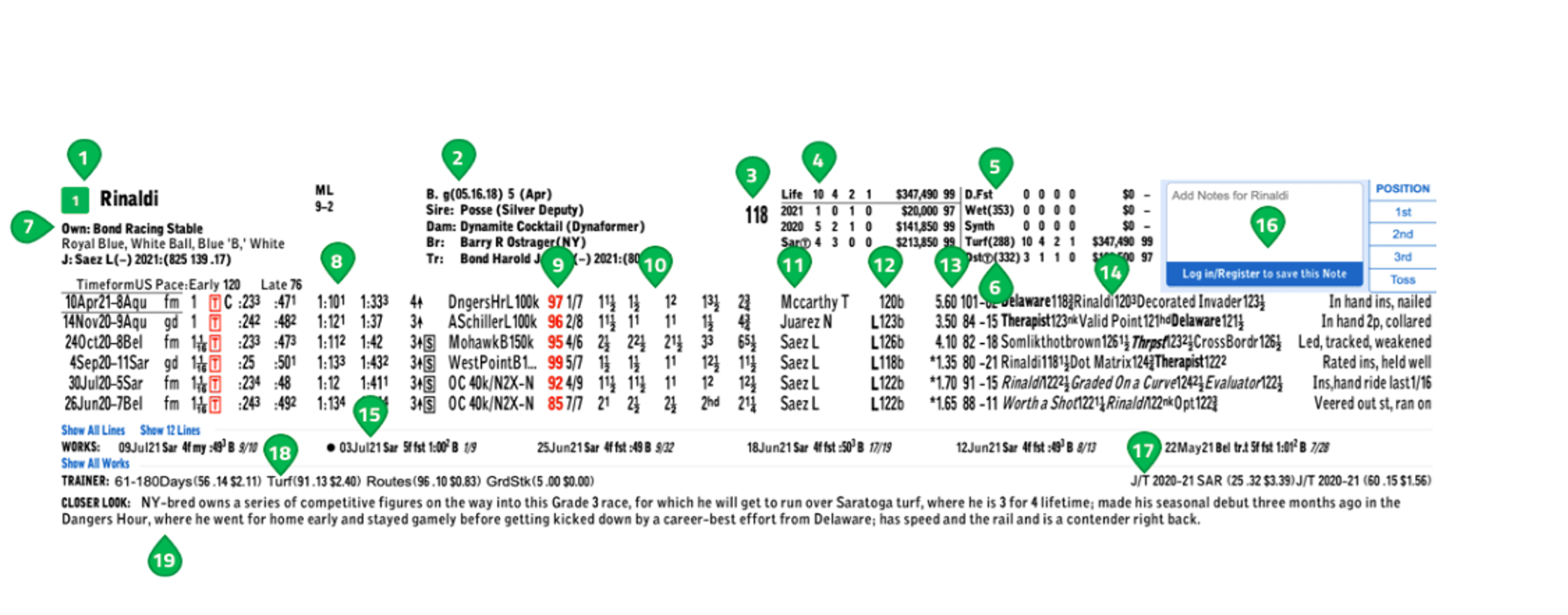
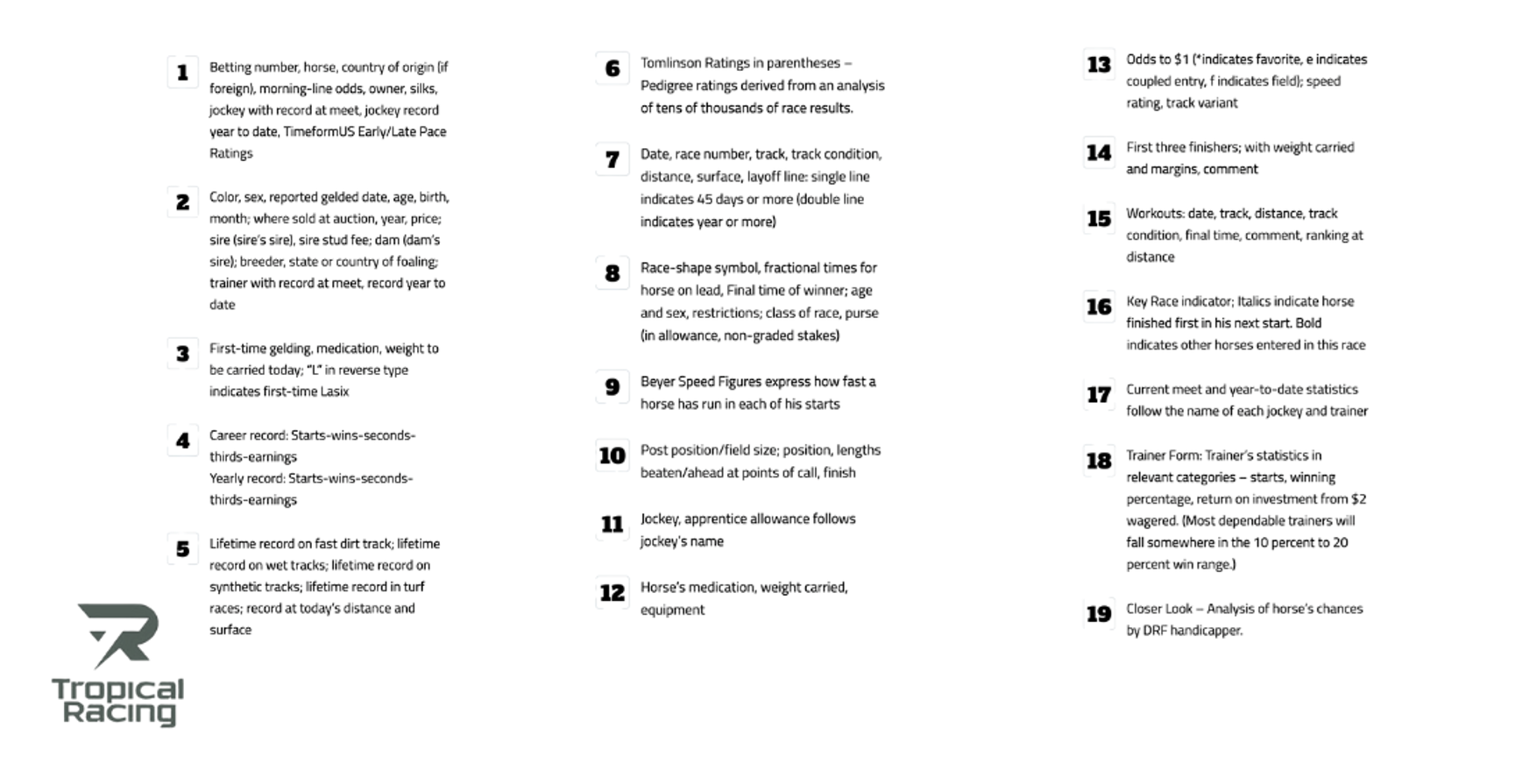
Example Header (U.S. format):
What This Means:
- Race number: The order of the race on the day’s card.
- Race type: Tells you what category the race falls under (g., maiden, claiming, allowance, stakes).
- Distance: How far the horses will run (in furlongs, meters, or miles).
- Surface: Indicates whether the race is on dirt, turf, or synthetic.
- Purse: The total prize money to be divided among the top finishers.
- Conditions: Who can run in the race. This is based on age, gender, or past wins.
Example: Race 3 – Maiden Special Weight – 6 Furlongs – Dirt – Purse: $60,000
Understanding these elements gives you the context before even looking at the horses themselves.
Decoding a Horse’s Line in the Form
Each horse will have a block of data summarizing its career. Though formats vary slightly, most follow a consistent structure. Here’s an example (simplified):
#6 – MOUNT RUNDLE (KY) 6 b.g. (May 1) (Jack Milton – Beaucoup, by English Channel)
- Owner: Circle 8
- Trainer: Michelle Nihe
- Jockey: Alex Achard
- 2025: 4 1 1 0 $105,177 – 2024: 1 0 0 0 $1,375 – Lifetime: 15 2 3 3 $295,638
- Last race: 2nd, Allowance, 1m Turf, GP, Mar 10 – Beaten HD by Echo Lane
- Odds: 15/2
Let’s break down what each section means.
Horse Name and Details
- Number (#6): The horse’s number in today’s race, corresponding to the saddlecloth.
- Name (MOUNT RUNDLE): The registered racing name.
- (KY): Indicates the state or country where the horse was bred. In this case, Kentucky.
- 6 b.g.: The horse’s age, color, and sex — 4-year-old bay gelding.
- Pedigree: Lists the sire (father) and dam (mother), often with the dam’s sire noted after a comma.
Connections
- Owner: Who owns the horse (Circle 8, in this case).
- Trainer: The dedicated person who trains the horse.
- Jockey: The rider booked to ride today.
Connections matter, while successful jockey/trainer combinations can be a strong recipe for success.
Race Record Summary
The following line provides the horse’s career statistics:
2025: 4 1 1 0 $105,177
This means the horse has run 4 times this year, won 1, placed 2nd once, finished 3rd 0 times, earning $105,177.
Below that, lifetime totals and last season’s records are often displayed, and will show the same format.
Tip: A horse improving with each run this season may be approaching peak fitness — a positive sign for bettors and owners alike.
Past Performance Lines
This is where the heart of the form lies — the past performances (PPs).
Each line represents a recent race and typically includes:
Date | Track | Race Type | Distance | Surface | Finish | Odds | Comment
Example: June 22 | CD | Alw | 1m Turf | 2nd by HD | 15/2 | Settled midfield, challenged wide on home turn, just failed.
Here’s how to interpret it:
- Date & Track: When and where the race took place (CD = Churchill Downs).
- Race Type: Allowance (non-claiming, mid-tier race).
- Distance & Surface: 1 mile on turf.
- Finish: The horse finished 2nd, beaten a head.
- Odds: 15/1 — the betting odds at post time.
- Comment: A brief trip summary describing how the horse ran.
Common Abbreviations in Past Performances
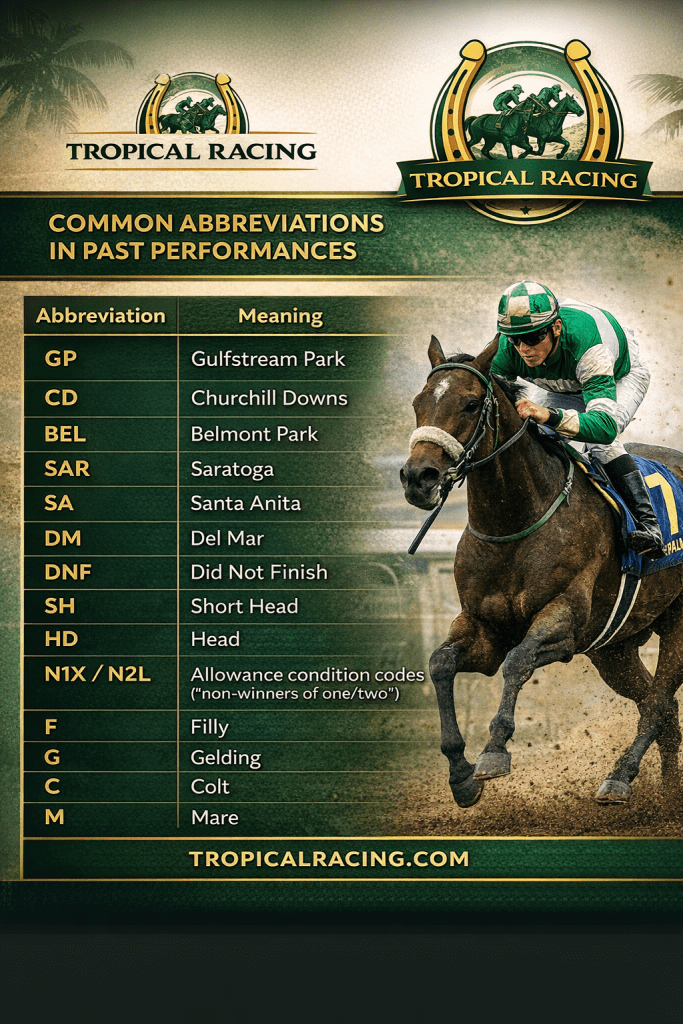
Abbreviation & Meaning
- GP – Gulfstream Park
- CD – Churchill Downs
- BEL – Belmont Park
- SAR – Saratoga
- SA – Santa Anita
- DM – Del Mar
- DNF – Did Not Finish
- SH – Short Head
- HD – Head
- NK – Neck
- N1X / N2L – Allowance condition codes (“non-winners of one/two”)
- F – Filly
- G – Gelding
- C – Colt
- M – Mare
Learning these abbreviations helps you quickly understand the “racing jargon” when scanning a field of runners.
Understanding Key Racing Form Statistics
Beyond the basic results, the racing form provides several metrics and figures to help you compare horses.
Here’s what to pay attention to.
Speed Figures
One of the most important indicators, especially in the U.S., is the Beyer Speed Figure (BSF) or Speed Rating.
- A higher figure indicates a faster performance.
- Figures are adjusted for track conditions and distances, allowing comparisons between races.
For example: MOUNT RUNDLE – Speed Figures: 84, 86, 88 in last three starts.
This steady improvement suggests that Mount Rundle is improving.
Class Level
Horses race in various “classes” depending on their ability. From lowest to highest, typical American categories include:
- Claiming races (any horse in the race can be purchased for a listed price).
- Allowance races (non-claiming, for developing/progressing horses).
- Stakes races (Graded races).
Class drops (dropping down to an easier level) can indicate a horse looking for confidence or form. Stepping up in class can signal ambition from connections on the back of recent improvement from their horse.
Weight Carried
Each horse carries a set amount of weight (including the jockey’s weight and equipment).
- In handicaps, higher-rated horses carry more to level the field theoretically.
- In allowance or stakes races, weights are determined by conditions (age, sex, or prior stakes-level wins).
A drop of a few pounds can be the difference between winning and losing, especially in sprint races.
Post Position
The post number (the horse’s gate/stall position) can affect how the race unfolds.
Inside draws can be an advantage on dirt tracks, while wide posts may favor turf specialists with more room to settle. But you should also note how your horse prefers to race.
For example: If your horse performs to his best when held up off the speed, then gate 1 will not be advantageous. At the same time, a higher gate would play more to your horse’s strengths.
Track bias, where certain parts of the track perform better, is another layer that experienced fans watch closely. The golden highway is a racing term that you may hear to describe a specific advantageous section of the track.
Jockey and Trainer Stats
Every racing form includes statistics for each trainer and jockey, which are often expressed as win percentages.
Example:
Trainer: J. Smith (2025): 18% wins from 120 starts.
Jockey: L. Saez (2025): 20% wins, 55% top-three finishes.
Combining a top jockey and an in-form trainer often signals that a horse is ready to win.
Track Conditions and Notations
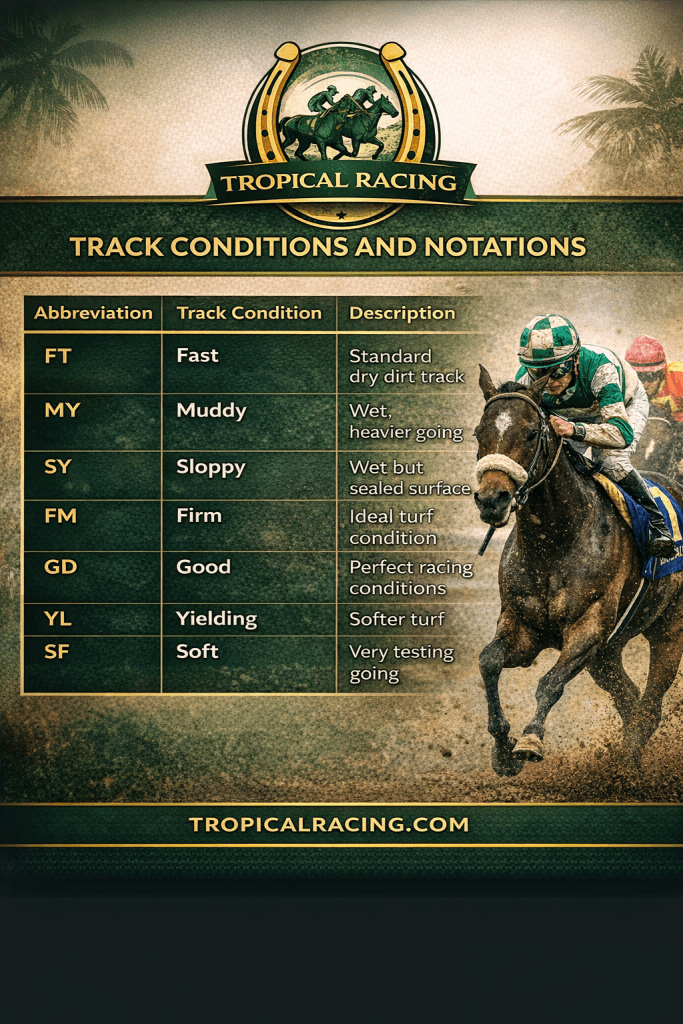
Track conditions can dramatically impact results, and racing forms provide this context for each past performance. And this is a vital asset.
Abbreviation – Track Condition – Description
- FT – Fast – Standard dry dirt track
- MY – Muddy – Wet, heavier going
- SY – Sloppy – Wet but sealed surface
- FM – Firm – Ideal turf condition
- GD – Good – Perfect racing conditions
- YL – Yielding – Softer turf
- SF – Soft – Very testing going
Tip: A horse that runs well on “muddy” or “yielding” surfaces may be labeled as a mudlark. This type of horse may have a higher knee action, well-suited to softer turf conditions.
Interpreting Comments and Running Styles
The short comment line beneath each race summary tells you how the horse actually ran, which can reveal much more than the finishing position alone.
Examples:
- “Pressed pace, led, weakened late” – showed early speed but tired.
- “Rallied from back, gaining steadily” – closer with a strong finish.
- “Stumbled start, lost chance” – trouble early that explains a poor result.
Running styles generally fall into three categories:
- Front-runner (Early speed) – leads from the start.
- Stalker (Pressing) – sits just behind the leaders.
- Closer – settles off the pace and finishes late.
Understanding pace setups helps predict which horses might be favored by today’s race conditions.
The more horses that like to press the pace in a race, the more likely it is that the race will set up for a closer.
Understanding Odds and Betting Information
Every racing form includes the morning line odds — the track handicapper’s prediction of how the betting market will shape up.
For example:
- 3-1 – A $2 bet returns $8 total ($6 profit).
- 10-1 – A $2 bet returns $22 total ($20 profit).
While odds may reflect public opinion, they can also hint at stable/connections confidence when a horse’s price shortens before post time.
Tropical Racing Tip: Always balance odds with form. A well-bred, consistent horse with solid speed figures can offer better long-term value than chasing outsiders with little chance purely for a big payout.
When betting on horse racing, remember, it is all about long-term profit.
International Differences in Racing Forms
Though the U.S. style of form emphasizes speed figures and class levels, other regions display data differently.
UK & Ireland
- Focuses on finishing positions, ratings, and ground conditions.
- Finishing percentages and sectionals (splits) have become more popular in flat racing.
- Abbreviations like “PU” (pulled up), “UR” (unseated rider), “SU” (slipped up), and “RO” (ran out) appear in jumps races.
- Race distances are listed in miles, furlongs, and yards. Whereas weights are displayed in stones and pounds.
Australia
- Strong emphasis on barriers (post positions), last 600m times, and sectionals (splits).
France & Hong Kong
- Feature official ratings and prize earnings prominently, reflecting graded class structures.
- Abbreviations like “PU” (pulled up), “UR” (unseated rider), “SU” (slipped up), and “RO” (ran out) are also used in France for jumps racing.
By comparing global formats, racing enthusiasts can build a more complete understanding of how performance data translates internationally—an advantage for syndicates like Tropical Racing, which engage with owners and horses across the borders.
Putting It All Together – A Step-by-Step Example
Let’s analyze a mock race entry and show how to interpret it.
- #3 SUNLIT RIDER (FL) 3 ch.c. (Mar 10) by Speightstown – Desert Bloom, by Distorted Humor.
- Owner: Circle 8
- Trainer: Brown
- Jockey: Ortiz Jr.
- 2025: 3 1 1 0 $75,000 Lifetime: 3 1 1 0 $75,000
- Last 3 Starts: Mar 15 GP Alw 7f Dirt 1st by 1½ 2/1 Rated kindly, drew clear, strong finish. – Feb 10 GP Msw 6f Dirt 2nd by ¾ 4/1 Broke slow, rallied, solid debut.
- Beyer: 80–86 trend upward.
- Trainer/Jockey combo: 23% win rate in 2025.
Analysis:
- Lightly raced colt showing progression from second on debut to a confident win.
- Strong trainer/jockey partnership.
- Consistent speed figures.
- Versatile dirt performer over sprint distances.
Verdict: An improving young horse who is likely to improve at allowance level.
Tips for Reading Racing Forms Like a Pro
- Focus on Recent Form: Last 3–5 races tell you more than lifetime totals.
- Note Surface Changes: A horse moving from turf to dirt (or vice versa) can transform or hinder its performance.
- Watch Class Movements: Dropping in class signals a horse dropping in class, looking to record a win.
- Check Layoffs: Horses returning after long breaks (e.g., 120+ days) may need a race to regain fitness (checking morning work can help with your decision to play or lay).
- Study Trainer Patterns: Some trainers excel with first-time starters; others excel with horses arriving from other yards.
- Use Trip Notes: Comments often paint a better picture of past performances.
- Don’t Ignore Post Time Odds: Late money from informed bettors or connections must be taken seriously.
- Compare Speed Figures: Look for upward trends rather than isolated peaks.
- Adjust for Track Bias: Research how the track played earlier that day. Was the inside rail faster, or are they finishing faster down the middle of the track?
- Combine Data with Instinct: Numbers guide you, but context and understanding of the horse complete the picture. With enough study and research, your instinct can take over.
Reading the Form as a Tropical Racing Syndicate Member
As a Tropical Racing owner, reading a form isn’t just about betting — it’s about a connection with your horse.
The numbers tell the story of your horse’s journey. The lessons learned, the progress made, and the journey that might lie ahead.
When you open the racing form and see your horse’s name, you’re not just reading statistics; you’re tracing months of preparation and care that took place behind the scenes.
Understanding the form deepens your appreciation of what it takes to bring a Thoroughbred to peak performance.
Tropical Racing prides itself on transparency and education — giving syndicate members the insight to engage with every aspect of the Tropical Racing experience.
Conclusion
Whether you’re cheering on your Tropical Racing syndicate horse, studying a Derby contender, placing your first wager, or falling in love with national hunt racing, the knowledge you gain from reading the racing form transforms you from a casual fan into a true student of the game.
So next time you open the racing form, don’t be overwhelmed — read between the lines, look for patterns, and enjoy the process.
Every figure and comment is another piece of the puzzle, helping you understand what makes this incredible sport both an art and a science.